woensdag 10 juli 2013

Tim Orr (USA) - Advanced Wheres and Action


Tim Orr is an actor and trainer from San Francisco, who played with renowned groups like 3 For All and True Fiction Magazine. He now owns his own company Improv Playhouse of San Francisco and has been visiting The Netherlands every two years since he performed at the Amsterdam impro festival in 2005.


For his 2013 tour he visited 3 countries to teach Dutch, Belgian and French improvisers (almost) everything he knows that can add to better improvising.

And it started all with the weekend intensive Advanced Wheres and Action. About this workshop Tim said: "I haven’t taught this yet in Amsterdam. I think that people would love it!"

After 2,5 days of swimming in the Olympics, getting lost in horror houses, flying helicopters and chasing murderers on a merry-go-round, that was indeed what had happened: all 14 participants loved it. And each other. And Tim for inspiring each of them tremendously. 

To close, the master himself speaks:

"Many thanks to all my students, friends and colleagues in Amsterdam and throughout The Netherlands for an awesome month of improv!  It's an honor to work and play with you.  Special thanks to Lady Laura Doorneweerd for a great job of organizing all the workshops, and also to All Improv for its support. Hope to see you next year!" 

vrijdag 19 april 2013

Mischler and More

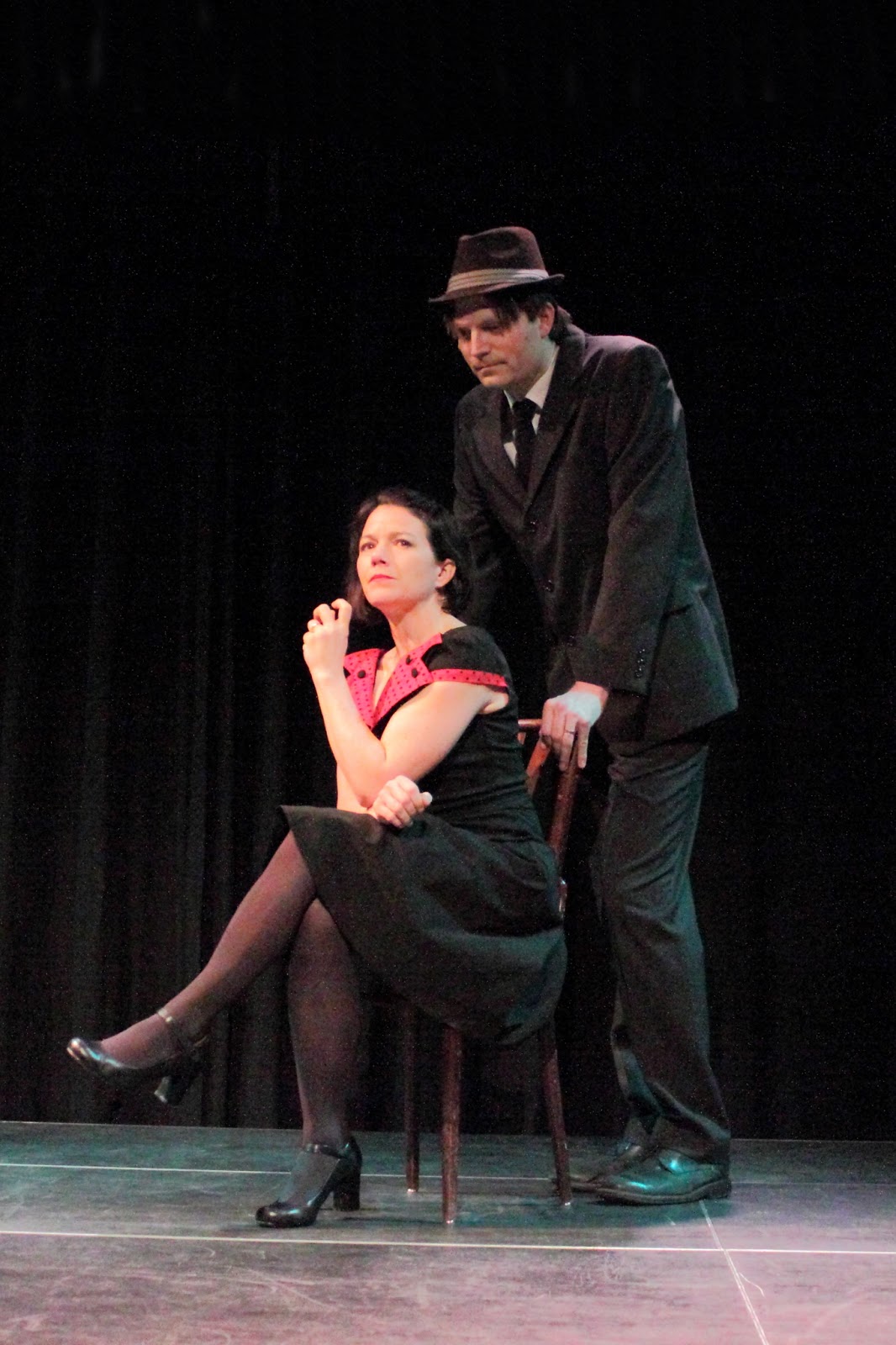
Mischler and More is a collaboration between two established Amsterdam-based improvisers, Nicole Mischler and Peter More. Nicole and Peter have been working together for years in various groups and decided to use their obvious chemistry and love of a challenge to try creating genre-based narrative longform show with just the two of them. By really delving into the genre and avoiding the usual superficial, cheap jokes of much improv genre work they have worked on two well-received "formats" so far, in the style of Shakespeare and Film Noir. There is the promise of more to come.

Thanks to allimprov and easylaughs help, they were able to quickly get off the ground and be dressed for the part. They have even already started making an impact on the festival circuit, starting with the huge Chicago Improv Festival, performing as one of five international groups. Their next festival is the less-well-known Delft Fringe and the hope to have another show in Amsterdam before that comes out.

Like them on Facebook to be kept up to date: facebook.com/MischlerMore

maandag 15 april 2013

Kevin Gillese (Rapid Fire Theatre) teaching two workshops

Kevin Gillese of Rapid Fire Theatre fame is coming to Amsterdam and teaching two workshops:

1. Shortform impro comedy: Saturday April 20th, 13:00 - 15:30, Crea Amsterdam.
Price: € 30,- per person. Max number of participants: 12. Experience level: All


Description:
Kevin has performed more Theatresports than anything else, and in this workshop he will be bringing all his favourite games and structures to play around with. You will brush up on some games that you have forgotten about, and learn some new ones too. In addition to this the instructor will share his personal tips and tricks for strong short form scenes. As we all know, having strong improv skills is only half the work, the other half is knowing how to play the format that you're in, and that's what this workshop is all about: mastering the art of short, improvised comedy scenes.

2. Narrative in longform: Saturday April 20th, 16:00 - 19:00, Crea Amsterdam.
Price: € 30,- per person. Max number of participants: 12. Experience level: Must have some experience with long form improv.


Description:
Kevin's personal improv philosophy is that narrative is a fundamental part of almost every type of improvised theatre, and that not enough focus is given to developing those storytelling skills. In this workshop Kevin will go over all the building blocks of narrative (objectives, super objectives, conflict, narrative arcs, etc.) and then lead the group through a variety of exercises designed to strengthen those specific muscles.

Kevin is mostly known from his 2-men improv group "Scratch". He performs all over the world and has a wonderful style of teaching.

Apply by e-mailing to: david@groenbrothers.com.

Payment can be cash at the workshop, or if preferred by invoice.

OFFER: if you attend both workshops, you pay only € 50 for 2 workshops!

donderdag 13 december 2012

Harri Olli from Switzerland and Dizzy and the Pit Kittens


The night of the 17th of November held for improv lovers a very special occasion


at CREA: the groups Harri Olli from Switzerland and Dizzy and the Pit Kittens
teamed up to show a variety of longform styles and foster international improv
exchange.

First Dizzy at the Pitt Kittens took the stage to perform their show ‘Whirlpool’.
This format highlights the power of the combination of abstract scene work,
realistic scenes, and colorful stories. In a collage of scenes inspired by the
two words betrayal and paranoia. After presenting an improvised dance, in
which everyone of the four performers took the lead at some point, to lure the
audience in and probably warming up their bodies Dizzy and the Pitt Kittens
took the audience on a journey through single scenes and reoccurring stories
about cheating wives, rejection in social groups, the royal hierarchies and land
ownership among lions, the old rivalry between postman and dog, and others.

They presented not only how to stay in and instantly refind strong characters but
also how to organically transform smoothly from one scene to the next with all
players on the stage at all times, even if the scene is only about two or even one
person. This was for the spectator surely the most inspiring experience, leaving
us with the question “How the hell did they do that?”.

It was clear that there were four highly skilled and well assembled performers
on stage who seem to have found an outstanding level of groupmind and who
dare to go to places very few other improv groups would take their scenes:
funny, sad, and abstract all in one show.
(by: Gerald Weber)

In the second half the three players of the Swiss longform group Harri Olli took
to the stage. The two founders Gerry and Simone trained this year with BATS
from San Fransisco and brought BATS format ' The Naked Stage' with them to
Zurich.

Earlier in 2012 the duo had performed their two men show (also made possible
by All Improv) and for this second performance they invited new group member
Niggi to perform with them. ‘The Naked Stage’ consisted of three acts, each with
a predetermined length in time, and no change of characters or location. The
audience suggested a shed for a location and the three performers told the story
of a man dealing with the relationship with his father now and in the past, and
how that affected his marriage.

The story evolved in a calm pace with a very interesting tension underneath it.
Regularly this tension was broken by the funny twists in the universe they had
carefully created. For instance when Sarah, the wife, made light hearted remarks
about issues that her husband had difficulty dealing with, both frustrating
and thawing him. It was in moments like this, that the actors could show their
experience as an ensemble and the acting skills that they individually own.

The evening ended with a short jam session with all seven players on stage in
which they showed themselves from even more different sides. The audience got
a full spectrum of abstract, serious, and light fun as a dessert.
(by: Laura Doorneweerd)

donderdag 27 september 2012

The Ripple Effect by Ryan Millar


I was delighted to have the opportunity (thanks to AllImprov and easylaughs) to come to
Amsterdam and lead a workshop on The Ripple Effect in at the CREA. The workshop came
after the international debut (yeah... ‘international debut’: I like the sound of that) of my
solo improv show Marbles.

The workshop activities were grouped under the heading ‘The Ripple Effect’ to suggest the
idea of following ripples and seizing in-the-moment discoveries. The session was the result
of a number of things I’ve come across while doing solo improvisation. They centre on two
main themes: one is authenticity, and the other is exploration.

Authenticity in improv means being entirely true to what’s happening in the moment; in
the room, in the scene, and with yourself. Complete honesty is really compelling onstage,
and even when you add in character and emotion and attitudes – and blur the lines
between reality and fiction – that doesn’t change. The performers should never be or seem
inauthentic. It’s difficult not to put up protective walls, but it’s good to at least identify when
it happens.

One of the most fun exercises on authenticity was actually inspired by the room
specifications. When I was booking it I found out the room had a stereo, so I decided to build
some dancing into the session. One reason is that I really enjoy dancing.

The other reason this seemed to make sense is that dancing can be used either as
self-expression or as armour to hide behind. (As typified by teenage boys at a school
social ‘pretending’ to dance, but too self-conscious to actually do so).

However, when people are completely committed to dancing (no matter how good or bad
they are) it's much more interesting. Of course, unless you’re supremely self-confident it’s
hard to dance by yourself in front of a group and not feel self-conscious. But in the workshop
we all did it, and experienced the different feelings. Leaving ‘the point’ of it all aside for a
moment: we had a pretty sweet afternoon dance party.

Afterwards, we did a number of exercises to help us get at the idea of riffing on (or
exploring) ideas. During the session I realized that it’s actually quite a rich area, and there
could've been at least a few more hours to the session.

If anything, finding an idea was the easiest part of the spontaneous monologues I had
people create; a number of people onstage discarded perfectly good ones trying to find
a ‘better’ one. In all cases, those first ideas were perfectly wonderful. Seizing the unexpected
idea or moment can turbo-charge scenes and stories and take them into unexpected,
risky and rewarding places. Though the work on riffing runs parallel to some other improv
concepts, the idea of discarding perfectly ideas – or ignoring rich accidents – to focus
on something that we hope (or expect) to be coming along is a far too often onstage
occurrence.

I know that applies to me, as I've been using these techniques to generate material for
solo improv and in other forms, but The Ripple Effect also seems like the kind of thing that
anyone could find useful, in their ‘real’ life or in other capacities.

It was over all too soon. But perhaps there will be a next time, and we can go deeper into
the ripples, and have an even bigger dance party.

zondag 23 september 2012

The Format


Director and improviser Gerald Weber from Zürich came to the Netherlands to teach the weekend workshop The Format. 

The Friday evening workshop focused on acting for longforms in which both intermediate and advanced improvisers took part.
Gerald continued with a smaller group for a full weekend of exercises, training for longforms and developing an own longform. 

The participants started off with sharing one part of the home work they received: sharing their most embarrassing moment. This resulted in inspiring nicknames like 'Window Smasher' and 'Best of Nothing', that were used the rest of the weekend.

On Saturday Gerald took the participants along a number of longforms, including the Armando Diaz Experience and the Harold. The training focused on spontaneity, archetypes, stage directions, ensemble work and honesty on stage.
 
On Sunday Gerald and the participants discussed what inspired them in the different longforms, which lead to the making of the new format. This format included monologues, scenes that build on each other and unexpected story lines. Napoleon's Bagel was born and in the early evening presented to an audience. 

It was an intense weekend and a sparkling show. After the show, visitors told us about the references they saw to great philosophers, movies and the Ducktales.

But foremost, this weekend has enriched the participants in many ways. To quote one: "I have been looking for this for years". 

A big thank you to All Improv for making this happen. 

woensdag 4 juli 2012

Samenvatting Dagdeel 4 Train de Trainer


Samenvatting dagdeel 4 – Train de trainer

We lopen na de lunch terug de ruimte in. Spontaan ontstaat een spel waarbij de spelers samen een letter vormen en deze letter als klank produceren.
(A….O…..U….E….).

Verder zal deze middag gaan over feedback.

Feedback gaat over kijken en zien en daar woorden aan geven.

Wij gaan dit ervaren door de volgende opdrachten.

1. Benoemen


We lopen allemaal rond en bekijken elkaar en de ruimte goed. Dan staan we allemaal stil met onze ogen dicht. André stelde vragen als: ‘hoeveel stopcontacten zijn er in deze ruimte? Steek het aantal vingers op’.

Vervolgens liepen we door de ruimte en benoemen we wat we zien.

Daarna lopen we weer rond en nu geven we alles een andere naam. Bij het bespreken van deze opdracht blijkt dat iedereen hiervoor een strategie kiest. Je kiest voor een strategie door de confrontatie met iets anders dan je gewend bent.
André benoemt dat je jezelf altijd moet toestaan om iets los te laten.
We doen dezelfde opdracht nog eens met het idee dat je fouten mag maken.
We krijgen mee: ‘zoek het moment van kortsluiting op. Je hoeft het (de naam van het voorwerp) niet te weten, het mag wel.’

Bij sommigen gaat het nu beter. Peter ziet zelfs andere voorwerpen voor zich en benoemt die.

André verteld dat deze opdracht bijna niet te doen is. ‘Het is iets dat gebeurt in je hoofd. Creativiteit wordt geblokkeerd door ‘dat is een box’.

Conclusie:
Merk dat je in je strategieën komt en laat het los. Zeg dan dat je het niet weet. Je mag het ‘niet weten’.


2. Pandora’s doos


We maken tweetallen. Nummer één heeft een doos waar alles inzit. Nummer twee haalt er steeds iets uit. Nummer één benoemt wat dit is.
Het verschil met de vorige opdracht is dat je nu zelf een voorwerp kunt ‘maken’. Verder is het eigenlijk dezelfde opdracht.

Ook hier is de essentie:
Toestemming geven aan jezelf om de betekenis los te laten. Ook in een scène kun je (in personage) benoemen dat je het even niet weet.

3. objectieve feedback


We wisselen van tweetal. Nu gaan we benoemen wat we zien aan de ander. Dit doen we zo objectief mogelijk.
Enkele ervaringen waren:
‘Prettig, je volgt je ogen’
‘Lollig om te ondergaan’
‘Ook wel weer gek dat iemand zegt wat hij ziet’.

Je voelt er bijna altijd wat van als iemand iets over je zegt wat direct over jou gaat. Het is belangrijk om te voelen waar je subjectiviteit insluipt en waar je objectief blijft.

We blijven in hetzelfde tweetal en wisselen van beurt. Weer beschrijft de één de ander zo objectief mogelijk.

André vraagt hoe we dit hebben ervaren en benoemt dat we alert moeten zijn op oordelen.
Bij de meeste mensen zit een systeem dat ‘verdedigt’.
Sommigen zetten dat om in weerstand, verdedigen of discussie. Dat zijn alle strategieën.

Dus: wat zijn strategieën die mensen toepassen als jij feedback geeft? Als je dit weet ga je niet in discussie over wat diegene zegt, maar over de strategie.

We wisselen van partner. Nu wordt feedback gegeven over opvallendheden.

Onderdeel van feedback: keuzes maken over waar je feedback op geeft.

Conclusie:
feedback hoeft dus niet zo objectief mogelijk. Het gaat ook over opvallende dingen waar je je op wil richten.

Het verdedigingssysteem is scherper bij feedback op opvallende dingen.

De beurt binnen het tweetal wisselt weer. Nu moet degene die nog geen feedback heeft gehad over opvallendheden, feedback bedenken over dingen die de ander aan hem zullen opvallen. Wat je aan jezelf opvallend vindt is anders dan wat andere opvallend vinden.
De werkelijkheid wordt gekleurd door hoe je je voelt, hoe je over de wereld denkt etc.

4. Flipover


André tekent het volgende op een flipoverblad:


CZ,LZ,LZ,LZ,LZ,PZ,PZ,PZ,PZ


CZ = comfort zone
LZ = leerzone; feedback op goede manier
PZ = paniekzone; afschuiven op andere dingen

5. Slechte feedback


Twee spelers op de vloer. De rest zit aan de kant. Zij gaan zo feedback geven over de scène.

Wanneer de scène is gespeeld gaan we over op de feedback. Wat is goede feedback en wat is slechte feedback?

Eén voor een springen we op om in het midden zo slecht mogelijk feedback te geven.

Er zijn verschillende stijlen van foute feedback:
·         Waardeoordeel/afkeuring
·         Lomp/ slordig (niet goed gekeken)
·         Over gevoelens heen walsen
·         Niet ter zake doende details (zoals hierboven beschreven, over het kiezen van feedback)
·         Feedback die niet past bij je doel
·         Niets zeggende feedback (leuk/ goed); niet concreet.

Bij beginners benoem je wat je ziet. Benoem het als kwaliteit en daag het uit.


6. Goede feedback


Nu geven we één voor een goede/ respectvolle feedback.
De spelers ervaren dit als fijn. Zeker het horen van ‘bedankt voor deze scène’ in combinatie met oogcontact.
Tip: houd de spelers op toneel tot het einde van de feedback, zodat ze het eventueel opnieuw kunnen doen.

Wat gemist werd is de vraag aan de spelers zelf; hoe vonden zij het gaan?

7. Drietal feedback

De groep wordt  verdeeld in drietallen. A & B spelen een scène van maximaal 1,5 minuten. C geeft feedback over de scène. A & B geven vervolgens feedback over de feedback van C.
Dit rouleert zodat iedereen aan de beurt is geweest.

Er zijn 4 elementen in goede feedback:
1.       Beschrijven wat je ziet. “wat daar gebeurde was…”
2.       Het effect daarvan
3.       Check “klopt het?” “hoe heb jij het ervaren?”
4.       Tip, top, flop. (Iets wat goed ging, iets dat beter kan en iets dat slecht ging)